

This guide is for dispensary owners and operators in California trying to figure out how to choose a security guard company, usually because a compliance deadline, an insurance requirement, or an actual incident just moved the decision from someday to now. If you’ve already called two or three companies and come away with a vague price, a generic pitch, or the feeling that they don’t quite understand what a licensed cannabis retailer actually needs, you’re not imagining it.
Dispensary security sits at the intersection of state cannabis regulation, private security law, and the everyday reality of running a cash-heavy retail business. Get it right and it fades into the background. Get it wrong and it becomes the reason a regulator, an insurer, or your own investors start asking hard questions. Here’s what actually matters, in plain terms.
Key Takeaways
- California dispensaries with a storefront must have on-site security personnel who are BSIS-licensed and at least 21 years old, three years above the general 18-year-old minimum for a standard guard card.
- DCC video surveillance rules are specific: minimum 1280×720 resolution, continuous recording at a minimum of 15 frames per second, and at least 90 calendar days of retention.
- The regulation itself doesn’t require armed guards. That decision comes down to documented risk, not a default setting.
- A vendor who can’t produce a license number, individual guard cards, and written post orders on request isn’t a bargain. It’s a liability with a monthly invoice attached.
- The companies worth hiring can answer compliance questions specifically, not just talk about security in general terms.
What’s in This Guide
- Why Dispensary Security Doesn’t Work Like Other Storefronts
- What California Actually Requires From Your Security Provider
- The Real Risk Picture
- Armed or Unarmed: What Actually Decides It
- Nine Questions to Ask Before You Sign
- Red Flags Worth Walking Away From
- Frequently Asked Questions
- The Bottom Line
Why Dispensary Security Doesn’t Work Like Other Storefronts
Cannabis is still a Schedule I substance under federal law, which keeps many banks from touching cannabis-related accounts and leaves a large share of the industry working mostly, or entirely, in cash, according to ASIS International, the professional association for security practitioners. Combine that with high-value inventory and a business type that parts of the mainstream economy still treat with suspicion, and you get a risk profile that doesn’t look like a typical retail store, a restaurant, or an office building.
That’s exactly why a security company that shrugs at cannabis clients, or treats your account like an afterthought, isn’t a minor annoyance. It’s a sign they haven’t thought about what actually threatens your business. If you’ve been quoted the same generic package a company sells to a strip mall or a warehouse, that’s the tell. Dispensary security has to account for a regulator who can walk in and check your footage, an inventory system that has to reconcile down to the gram, and a threat pattern that looks different from an ordinary shoplifting problem.
What California Actually Requires From Your Security Provider

California’s cannabis security rules come from two separate regulators, and it helps to know which one governs what. The Department of Cannabis Control (DCC) sets the operational requirements tied to your license: what has to be filmed, how long footage is kept, and whether security personnel need to be on-site at all. The Bureau of Security and Investigative Services (BSIS) licenses the guards themselves, and its rules apply to every security company in the state, not only the ones serving cannabis clients.
The security personnel requirement
Under California Code of Regulations Title 4, Section 15045, a licensed retailer or microbusiness engaged in retail sales must hire or contract security personnel to provide on-site coverage during business hours, and those personnel must be licensed by BSIS. The regulation also sets the minimum age for cannabis security personnel at 21, three years above the general 18-year-old floor for a standard guard card. Non-storefront retailers, meaning delivery-only operations, are exempt from the on-site requirement, though most still keep guards on staff for deliveries and storage.
The camera requirement
Video surveillance is where most of the technical detail lives. Under Section 15044, cameras must record continuously at a minimum resolution of 1280×720 pixels and at least 15 frames per second, and they have to clearly capture activity within 20 feet of every entry and exit point, along with limited-access areas, storage rooms, and point-of-sale locations with enough clarity to identify a face. Footage has to be retained for a minimum of 90 calendar days and produced for the DCC on request.
The guard card itself
Separately from the cannabis-specific rules, every guard has to hold a valid BSIS Security Guard Registration, commonly called a guard card. That requires an FBI and DOJ background check through Live Scan fingerprinting, completion of Power to Arrest training before the card is issued, and 32 hours of security officer skills training within the first six months of registration (16 hours in the first 30 days, 16 more within six months), followed by 8 hours of continuing training every year after that.
The DCC also requires a written, department-approved security plan before a license is issued in the first place, and it holds ongoing disciplinary authority, including citations and license action, for operators who fall out of compliance later. If you want the fuller walkthrough of what a compliant plan actually needs to cover, we’ve written a longer guide to regulatory compliance and security for cannabis dispensaries.
| Requirement | General BSIS Guard Card | Cannabis Retail Security Personnel |
|---|---|---|
| Minimum age | 18 | 21 |
| Background check | DOJ/FBI Live Scan | Same, plus BSIS license required |
| Pre-assignment training | Power to Arrest course | Same |
| Ongoing training | 32 hrs within 6 months, 8 hrs annually | Same |
| Legal basis | BPC Sections 7582 et seq. | 4 CCR Section 15045 |
The Real Risk Picture
Vehicle-ramming break-ins, usually called crash-and-grabs, have become common enough at dispensaries nationwide that ANSI approved a dedicated Cannabis Security Standard in 2024, built by an ASIS International technical committee of 25 security practitioners, most of them board-certified. The tactic itself is simple. A stolen or disposable vehicle is driven through a storefront, whoever is inside grabs what they can in the confusion, and the group is gone before police arrive. It doesn’t require a sophisticated crew, just the assumption that a dispensary has cash and product worth taking.
None of this is meant to scare you into a bigger contract than you need. It’s worth knowing because the two problems dispensary owners tend to treat separately, staying compliant and staying safe, are usually solved by the same handful of measures. A licensed guard who’s actually paying attention, cameras that meet the DCC’s technical bar, and a written plan that matches what happens on-site cover both at once. Splitting them into separate line items is usually where budget gets wasted.
Armed or Unarmed: What Actually Decides It

Neither the DCC nor BSIS requires armed guards at a dispensary. Section 15045 only requires that on-site personnel be licensed by BSIS. Whether you go armed comes down to a handful of practical factors: a documented threat history at your address, cash volumes on hand, what similar businesses nearby have experienced, and sometimes a requirement from your landlord or insurer.
If armed coverage does make sense for your property, know that it’s a separate credential on top of the guard card. A BSIS Firearms Permit requires the applicant to be at least 21, pass a separate FBI and DOJ background check, complete classroom and range training, pass a written exam, and pass a judgment and self-control assessment before the permit is issued. The permit is valid for two years and renewal requires four separate range qualifications over that term. A guard who’s simply been told to “carry” without going through that process isn’t legally armed. They’re a liability wearing a uniform.
For a lot of dispensaries, a well-trained unarmed officer with clear post orders and real de-escalation training does more for actual safety than an armed presence does, since most incidents are prevented long before they’d ever require force. You can read more about what unarmed security guards are trained and legally authorized to do if you’re weighing the two.
Nine Questions to Ask Before You Sign
Print this list, or keep it open on your phone, for your next round of vendor calls.
- Can you give me your BSIS Private Patrol Operator license number so I can verify it myself?
- Will every guard assigned to my property hold their own individual BSIS guard card, and can I see proof before they start?
- Have you worked with cannabis retailers before, specifically, not just retail businesses in general?
- What’s the plan if my assigned guard calls in sick or doesn’t show up for a shift?
- Will I get written post orders specific to my property, or a generic template?
- What’s your actual deployment timeline, and will you put that in writing?
- Can you provide a certificate of insurance naming my business?
- How is pricing structured, and what changes it: hours, armed versus unarmed, number of officers?
- If something goes wrong at 2 a.m., am I calling a person or a call center?
A company that answers all nine without hesitation, specifically, is worth a longer conversation. A company that gets vague on more than one or two isn’t ready for a cannabis account yet, whatever they claim on their website.
Red Flags Worth Walking Away From
- They can’t produce a PPO license number without being asked twice.
- They quote a flat price before asking about your hours, layout, or risk history.
- Guards show up without individual guard cards, or the company hesitates when you ask to see them.
- There are no written post orders, just a verbal description of what the guard will do.
- Your dispensary gets treated as a compliance checkbox instead of a client type they actually understand.
- You see a different guard almost every week, with no consistency in who knows your property.
Frequently Asked Questions
Do California dispensaries need armed security guards?
No. State regulation requires BSIS-licensed security personnel on-site during business hours for storefront retailers, but it doesn’t specify armed or unarmed. That decision is based on your property’s specific risk factors, not a legal mandate.
How much does dispensary security cost in California?
Cost depends on hours of coverage, number of officers, and whether you need armed or unarmed guards, plus any technology like cameras or access control layered on top. A vendor who can quote a firm number before assessing your property in person is usually guessing, not calculating.
Can I use unlicensed security to save money?
No, and it isn’t a gray area. Section 15045 specifically requires BSIS-licensed personnel for on-site security at storefront retailers. Using unlicensed guards puts your cannabis license at risk on top of the guards’ own legal exposure.
What’s the difference between a watchman and a licensed security guard?
A watchman is typically an unlicensed body with no formal training, background check, or legal standing beyond that of any private citizen. A BSIS-licensed guard has passed a DOJ and FBI background check, completed Power to Arrest training, and is working under a licensed Private Patrol Operator that carries legal accountability for their conduct.
Does DCC video surveillance replace the need for a guard?
No. Cameras document what happened. A licensed guard is there to prevent it from happening in the first place, and to respond in real time if it does. The DCC requires both for storefront retailers, not one instead of the other.
The Bottom Line
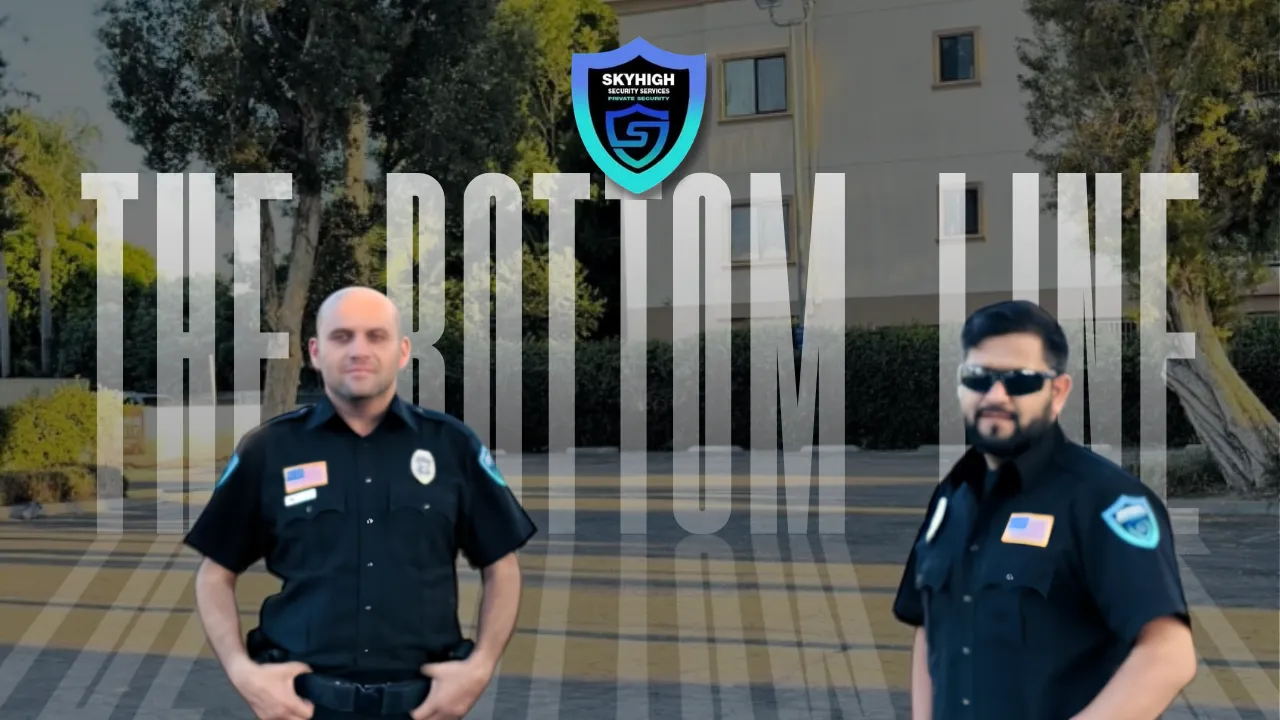
Choosing a security guard company for your dispensary comes down to verification, not persuasion. Check the PPO license number yourself. Ask to see individual guard cards. Get post orders and pricing in writing before anything is signed. A provider who treats those requests as routine, instead of an inconvenience, is telling you something important about how they’ll handle the rest of the relationship.
If you’re operating in Los Angeles County, the San Fernando Valley, or Ventura County, this is the kind of account we work with regularly. Skyhigh Security Services is a licensed California Private Patrol Operator (PPO #121165), founded by a U.S. Army veteran who managed security operations overseas before building a company around the same standards here. If you’d like a straight assessment of what your specific property actually needs, no generic package, no upsell, you can look at our dispensary security services or call 818-448-6969 directly.